

Hey there! I'm an abrasives supplier, and I've been in this industry for quite some time. One question I often get asked is, "How to test the quality of abrasives?" Well, I'm here to share some insights based on my experience.
1. Visual Inspection
The first step in testing abrasives is a simple visual check. You'd be surprised how much you can tell just by looking at an abrasive product. For instance, when you're dealing with Grinder Cutting Disc for Aluminium, take a close look at its surface. It should be smooth and free of any cracks, chips, or unevenness. Any visible flaws could indicate a manufacturing defect that might affect its performance.
The color of the abrasive can also give you some clues. A consistent color usually means a uniform composition, which is a good sign. If you notice any discoloration or streaks, it could be a sign of improper curing or contamination during the manufacturing process.
2. Hardness Testing
Hardness is a crucial factor in the quality of abrasives. It determines how well the abrasive can cut, grind, or polish a material. There are several ways to test the hardness of abrasives. One common method is the Mohs scale, which ranks minerals from 1 (softest) to 10 (hardest). While this scale is mainly used for natural minerals, it can give you a general idea of the relative hardness of an abrasive.
Another method is the Rockwell hardness test. This test measures the depth of penetration of an indenter into the abrasive material under a specific load. The harder the abrasive, the less the indenter will penetrate. This test is more accurate and is often used in industrial settings.
For example, if you're using a Metal Polishing Wheel for Grinder, you want it to be hard enough to remove scratches and imperfections from the metal surface but not so hard that it damages the metal.
3. Abrasive Grain Analysis
The abrasive grains are the heart of any abrasive product. Their size, shape, and distribution can significantly affect the performance of the abrasive. You can use a microscope to analyze the abrasive grains. Look at their size distribution. A good abrasive should have a relatively uniform grain size. If there are large variations in grain size, it can lead to uneven cutting or grinding.
The shape of the grains is also important. Sharp, angular grains are more aggressive and are better for cutting and grinding, while rounded grains are more suitable for polishing. You can also check for the presence of any broken or damaged grains. Broken grains can reduce the effectiveness of the abrasive and may even cause damage to the workpiece.
4. Bond Strength Testing
The bond is what holds the abrasive grains together. A strong bond is essential for the durability and performance of the abrasive. One way to test the bond strength is by subjecting the abrasive to a centrifugal force test. This test simulates the high-speed rotation of the abrasive during use. If the bond is weak, the grains may start to come loose or the abrasive may break apart.

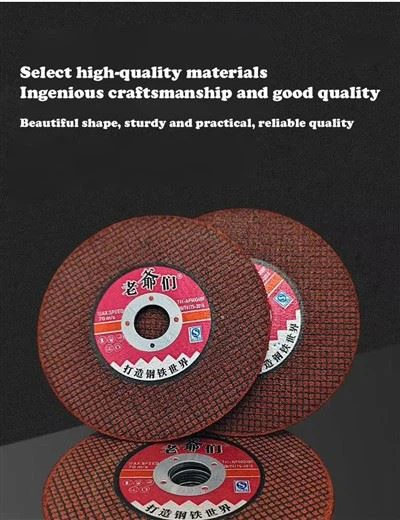
You can also perform a simple impact test. Drop the abrasive from a certain height onto a hard surface. If it breaks easily, it could indicate a weak bond. For example, a Wood Saw Blade For Grinder needs a strong bond to withstand the forces during cutting.
5. Performance Testing
Ultimately, the best way to test the quality of abrasives is to use them in real-world applications. Try the abrasive on a sample workpiece that is similar to the material you'll be working with. Observe how well it cuts, grinds, or polishes. Pay attention to the cutting speed, the quality of the finish, and the amount of wear on the abrasive.
If the abrasive cuts too slowly, it may not be aggressive enough. If it leaves a rough finish, it could be due to improper grain size or shape. And if it wears out too quickly, it may not have a strong enough bond or the abrasive grains may be of poor quality.
6. Chemical Analysis
In some cases, it may be necessary to perform a chemical analysis of the abrasive. This can help you determine the composition of the abrasive and identify any impurities or contaminants. You can use techniques such as spectroscopy or chromatography to analyze the chemical makeup of the abrasive.
For example, if you suspect that an abrasive contains a high level of impurities, it could affect its performance and may even be harmful to the workpiece or the operator. A chemical analysis can give you a clear picture of what's in the abrasive and whether it meets your quality standards.
Conclusion
Testing the quality of abrasives is a multi-step process that involves visual inspection, hardness testing, abrasive grain analysis, bond strength testing, performance testing, and sometimes chemical analysis. By using these methods, you can ensure that you're getting high-quality abrasives that will perform well in your applications.
If you're in the market for abrasives and want to ensure you're getting the best quality, don't hesitate to reach out for a consultation. We can provide you with samples and detailed information about our products. Whether you need Grinder Cutting Disc for Aluminium, Metal Polishing Wheel for Grinder, or Wood Saw Blade For Grinder, we've got you covered. Let's have a chat and find the perfect abrasives for your needs!
References
- ASTM International. (2023). Standard test methods for abrasives.
- ASM Handbook Committee. (2022). ASM Handbook Volume 16: Machining.


