

Are PVC Coated Gloves Heat Resistant?
As a supplier of PVC Coated Gloves, I often encounter questions from customers regarding the heat resistance of these gloves. In this blog post, I will delve into the topic to provide a comprehensive understanding of whether PVC coated gloves are heat resistant and under what circumstances they can be used in high - temperature environments.
Understanding PVC Coated Gloves
PVC coated gloves are a popular choice in various industries due to their versatility and affordability. These gloves typically consist of a fabric base, usually cotton, which is then coated with polyvinyl chloride (PVC). The PVC coating provides several benefits, such as enhanced grip, protection against chemicals, and resistance to abrasion. PVC Coated Gloves are commonly used in industries like construction, manufacturing, and warehousing.
Heat Resistance of PVC
To determine whether PVC coated gloves are heat resistant, we first need to understand the properties of PVC itself. PVC is a thermoplastic polymer, which means it can soften and deform when exposed to high temperatures. The melting point of PVC generally ranges from 100°C to 260°C (212°F to 500°F), depending on its formulation and additives.
When PVC coated gloves are exposed to temperatures approaching or exceeding their melting point, the PVC coating will start to soften. This can lead to a loss of the glove's structural integrity, including a reduction in grip and protection. In extreme cases, the coating may melt, which can not only render the glove useless but also pose a safety hazard to the wearer.
Factors Affecting Heat Resistance
Several factors can influence the heat resistance of PVC coated gloves:
- Thickness of the Coating: Thicker PVC coatings can generally withstand higher temperatures for a short period. A thicker layer provides more insulation and takes longer to heat up and reach its melting point.
- Additives in the PVC: Some PVC formulations contain heat - stabilizers and other additives that can increase the heat resistance of the material. These additives can delay the onset of softening and melting, allowing the gloves to be used in slightly higher - temperature environments.
- Duration of Exposure: Even if the temperature is below the melting point of PVC, prolonged exposure to heat can still cause the coating to degrade over time. The longer the gloves are exposed to heat, the more likely they are to experience changes in their physical properties.
Applications and Limitations
PVC coated gloves are not designed for use in extremely high - temperature environments. However, they can provide some level of protection in moderately warm conditions. For example, in light - duty tasks where the temperature is below 60°C (140°F), PVC coated gloves can still maintain their functionality.
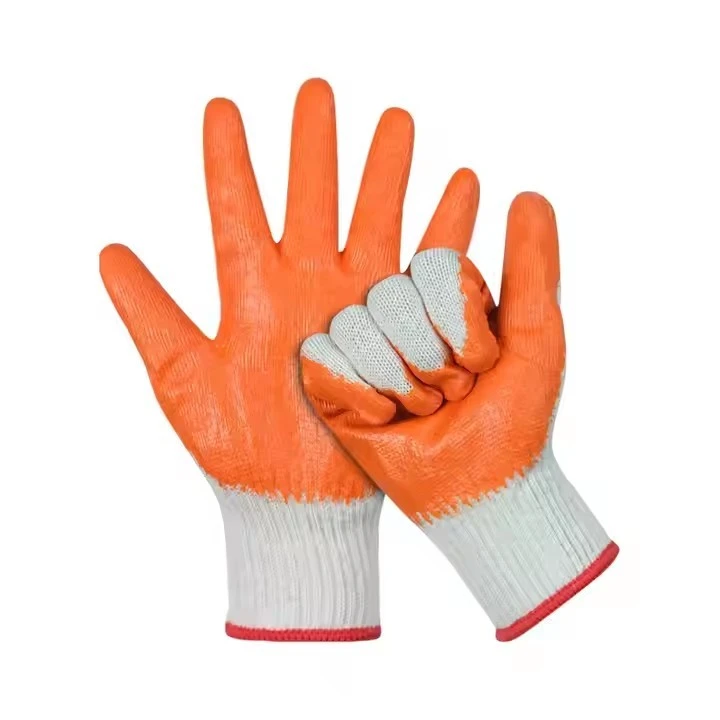

In industries such as food processing, where workers may handle warm items or work in moderately warm environments, PVC coated gloves can be a suitable choice. They offer protection against cuts, abrasions, and some chemicals, while also providing a good grip.
On the other hand, in industries like foundries, welding, or glass manufacturing, where temperatures can reach several hundred degrees Celsius, PVC coated gloves are not appropriate. In these high - temperature applications, specialized heat - resistant gloves made from materials such as Kevlar, Nomex, or leather should be used.
Comparison with Other Types of Gloves
When considering heat resistance, it's useful to compare PVC coated gloves with other types of gloves. Cotton Latex Safety Gloves and Cotton Latex Coated Gloves have different heat - resistant properties.
Latex has a lower melting point than PVC, typically around 70°C to 120°C (158°F to 248°F). So, in terms of heat resistance, PVC coated gloves may be a better choice in slightly warmer environments. However, neither latex - coated nor PVC - coated gloves are suitable for high - temperature industrial applications.
Conclusion
In conclusion, PVC coated gloves have limited heat resistance. They can provide some protection in moderately warm conditions, but they are not suitable for use in high - temperature environments. When selecting gloves for a particular task, it's crucial to consider the temperature range of the work environment, the duration of exposure, and the specific requirements of the job.
As a supplier of PVC Coated Gloves, I am committed to providing our customers with accurate information about the performance and limitations of our products. If you have any questions about the heat resistance of our gloves or need advice on selecting the right gloves for your application, please do not hesitate to contact us. We can help you make an informed decision based on your specific needs. Whether you are in the market for PVC coated gloves or exploring other options, we are here to assist you in finding the most suitable safety solutions for your workplace.
References
- ASTM International. (2019). Standard Test Methods for Rubber Property - Vulcanizates and Thermoplastics - Determination of Heat Aging Properties. ASTM D573 - 19.
- Plastics Europe. (2020). Polyvinyl Chloride (PVC) - Properties and Applications.


